Soil Types and Their Behaviour
Understanding the type and behaviour of soil beneath a site is an essential part of foundation design. Clay, sand, silt, gravel and organic soils each have different engineering properties and can respond differently to changes in load, moisture and groundwater conditions.
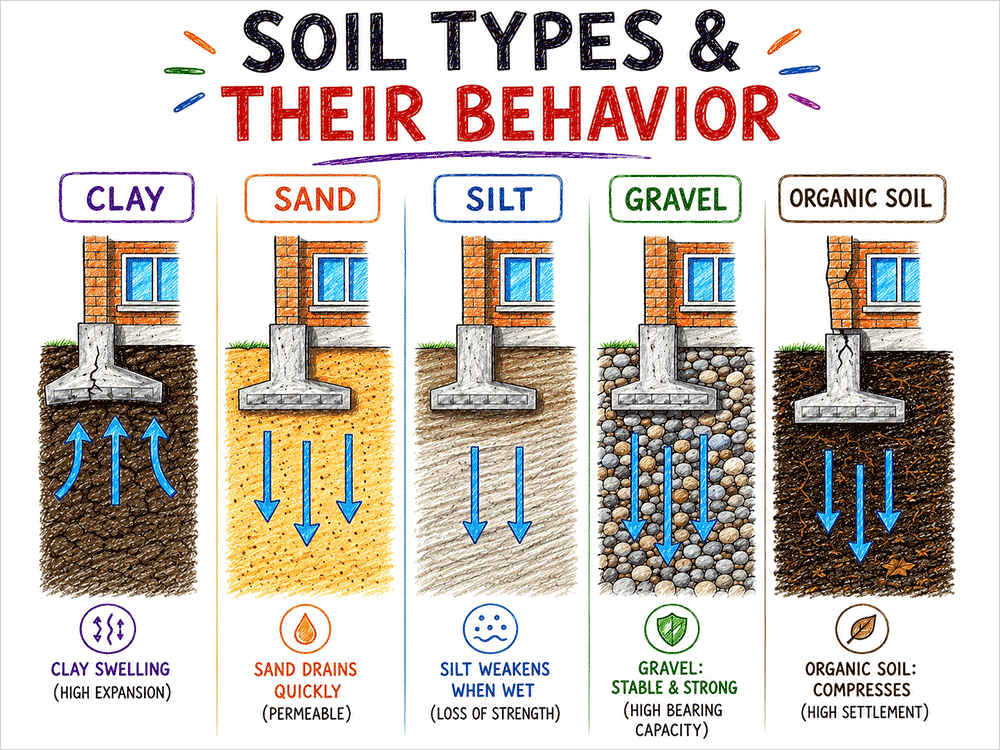
Clay soils may swell when they absorb water and shrink during dry periods. This movement can affect shallow foundations, particularly where trees, drainage problems or seasonal changes alter the soil’s moisture content. Sand is generally permeable and drains quickly, although loose or saturated sand may require careful assessment.
Silt can lose strength when wet and may be susceptible to settlement or erosion. Gravel generally provides good drainage and bearing capacity when it is suitably graded and compacted. Organic soils, including peat, are often highly compressible and may produce substantial settlement when loaded.
The descriptions shown in the graphic provide a general guide. Soil behaviour varies between sites and depends on its composition, density, moisture content, depth and geological history. A suitable ground investigation allows these conditions to be assessed before foundations are designed and construction begins.